



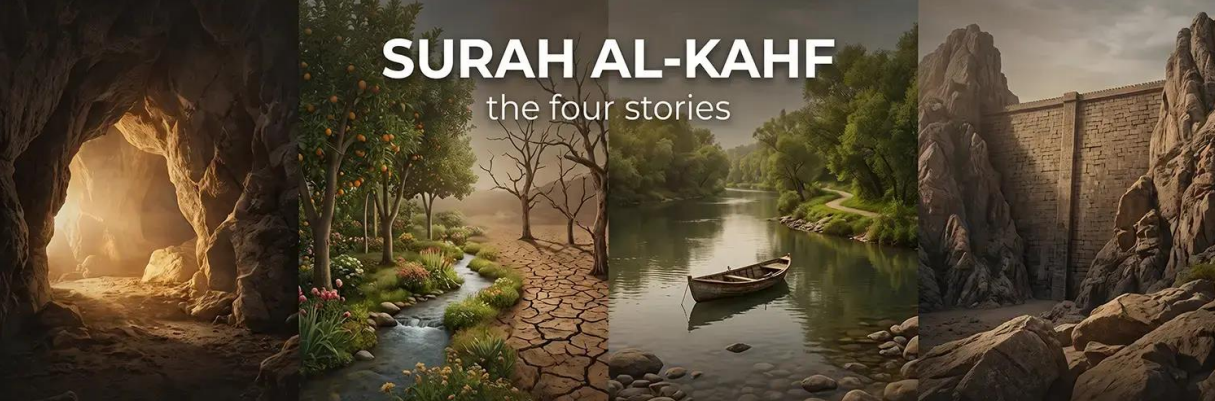
Surah Al-Kahf is the 18th chapter of the Quran, consisting of 110 verses. Muslims across the world are encouraged to recite it every Friday. Its four distinct stories, each addressing a different test of this worldly life, remain among the most widely discussed and deeply relevant passages in the entire Quran.
Table of Contents
The practice comes directly from the Sunnah. The Prophet ﷺ said:
"Whoever recites Surah Al-Kahf on Friday, a light will shine for him from one Friday to the next." (Al-Mustadrak of al-Hakim, 3392 graded authentic in Sahih al-Jami', 6470)
The Islamic day begins at sunset. For this reason, many scholars say the time for Surah Al-Kahf Friday recitation starts at Maghrib on Thursday and ends at Maghrib on Friday.
You can read it in one sitting or spread it across the day. Many people read a few pages after Fajr and complete it before Jumu'ah.
Protection from the Dajjal is one of the most cited Surah Al-Kahf benefits. The Prophet ﷺ said that whoever memorizes the first ten verses of Surah Al-Kahf will be protected from the Dajjal (Sahih Muslim, 809). Another narration in the same Hadith mentions the last ten verses.
Many scholars also draw a reflection from the Surah. Its four stories match four kinds of fitnah: faith, wealth, knowledge and power. The Hadith itself does not list these four. Still, the link helps readers see how the Surah prepares the heart.
A group of young men lived among people who worshipped others besides Allah ﷻ. Holding on to Tawheed put their safety at risk. So, they left their town and took shelter in a cave.
Allah ﷻ made them sleep there for three hundred years and added nine more (18:25). When they woke, they thought they had slept a day or part of a day (18:19).
Allah ﷻ describes them in these words:
"Indeed, they were youths who believed in their Lord and We increased them in guidance." (18:13)
The trial of faith in Islam is often a social one. For these youths, belief cost them their homes and their community. Allah ﷻ made their hearts firm because they stood up for the truth first (18:14).
The passage also carries a small instruction with a lasting effect. Allah ﷻ tells the Prophet ﷺ never to say he will do something tomorrow without adding In sha Allah (18:23-24).
The Two Gardens story in the Quran describes a man given two gardens of grapes. Date palms surrounded them, crops grew between them and a river flowed through the middle (18:32-33).
His words showed what the wealth had done to him:
His believing companion reminded him that he was created from dust and then from a drop of fluid (18:37). Then he advised:
"Why did you not say, when you entered your garden, What Allah willed. There is no power except in Allah." (18:39)
Soon after, the fruits were destroyed. The man was left turning his hands over what he had spent. He wished he had never associated anyone with his Lord (18:42).
Masha Allah means "what Allah willed." In this verse it comes with La quwwata illa billah, meaning there is no power except in Allah. Saying it admits that a blessing came from Allah ﷻ and stays only by His will.
This is the core of the trial of wealth in the Quran. The man's gardens were never the problem. Forgetting their Owner was. The Quran's teaching on Shukr carries the same idea: "If you are grateful, I will surely increase you" (14:7).
Prophet Musa (AS) was asked who was the most knowledgeable of people and he said, "I am." Allah ﷻ told him that a servant at the junction of the two seas knew what he did not.
The Quran does not name this servant. The Hadith identifies him as Khidr.
Musa (AS) asked permission to follow him and learn (18:66). He promised patience, if Allah willed (18:69). Then three events tested that promise:
Khidr ended by saying he did none of it on his own accord (18:82).
The Musa Khidr knowledge humility lesson is clear. Even Kalimullah, a Prophet who spoke with Allah ﷻ, was shown the limits of human knowledge.
What looks like harm may carry mercy. A loss today may be protection for tomorrow. Trusting Allah's wisdom, especially when His plan is hidden, is itself an act of faith.
The Dhul-Qarnayn story begins with people asking the Prophet ﷺ about him (18:83). Allah ﷻ gave him authority on earth and the means to reach his aims (18:84).
He travelled to the far west and ruled with justice there. He punished those who did wrong and rewarded those who believed and did good (18:86-88). Then he travelled to the far east (18:90).
On his third journey, he reached a people between two mountains. They told him that Yajuj and Majuj were spreading corruption in the land and they offered him payment for a barrier (18:94).
He declined the payment:
"That in which my Lord has established me is better. So assist me with strength, I will make between you and them a barrier." (18:95)
He built the barrier with iron blocks and poured molten copper over it (18:96). When it was complete, he did not claim any credit for himself. He said, "This is a mercy from my Lord" (18:98).
Dhul-Qarnayn could have taken wealth, fame or control. Instead, he used his authority to protect people who could not protect themselves.
Every provision, whether wealth, knowledge or authority, will be questioned before Allah ﷻ. This accountability is a theme the Quran returns to in its teaching on Rizq.
Surah Al-Kahf is not four separate stories placed together by coincidence. Each story addresses one of the four central trials of this worldly life.
Together they form a complete picture of the tests every human being faces. And the response in each story is the same at its core, return to Allah ﷻ, trust His wisdom, remain humble and use what you have been given with sincerity and gratitude.
The Quran placed these four stories in one Surah, to be recited every Friday, as a weekly reminder that the tests of this life are real but navigable for those who hold onto faith, gratitude, humility and responsibility before Allah ﷻ
Surah Al-Kahf is far more than a Friday recitation. It is a complete guide to the four trials of worldly life, addressed through four vivid and timeless stories. Each one carries lessons that remain as relevant today as they were at the time of revelation.
At Noor ul Burhan, our Para-wise Tafseer in simple Urdu helps readers understand Surah Al-Kahf and every other chapter of the Quran with the depth, context and clarity that make its lessons genuinely transformative, not just on Fridays but throughout the week.
1. Why read Surah Kahf on Friday according to Hadith?
The Prophet ﷺ said its Friday reciter receives a light between the two Fridays (Al-Mustadrak, 3392).
2. What are the four stories in Surah Al-Kahf?
The People of the Cave, the Two Men and Their Gardens, Musa and Khidr and Dhul-Qarnayn, each addressing a different trial of worldly life.
3. When does the time for Surah Al-Kahf Friday recitation begin?
Many scholars say it begins at Maghrib on Thursday and ends at Maghrib on Friday.
4. How does Surah Al-Kahf protect against the Dajjal?
Scholars connect the Surah's four stories to the four trials the Dajjal will bring: faith, wealth, knowledge and power. Regular recitation and understanding of the Surah prepares the heart against each one.
5. What does Masha Allah mean in the Quran?
It means "what Allah willed," as taught in Surah Al-Kahf 18:39.
6. How long did the People of the Cave sleep?
The Quran says three hundred years, plus nine (18:25).
7. What are the main Surah Al-Kahf benefits for a believer?
The benefits are light between two Fridays, protection from the Dajjal, and weekly guidance on life's four major trials.